Showing posts with label Veracruz. Show all posts

Wednesday, December 19, 2007

cascada post 25

Unknown Animals (y mas)

The other day, November 17, 2007 to be precise, I went out in my yard and noticed a strange bug on one of the leaves of a bird of paradise plant. At first I didn't think it was a bug or even alive. It was tiny, smaller than a pencil eraser, maybe about 3 mm in length (about 1/8 of an inch). I was standing there about 3 feet away and it looked like a whitish or grayish spec, maybe dirt or ash, or maybe some white mold or fungus. Then it moved. Hmm, that funny little thing is alive, I thought. I looked more closely and now I see it crawling slowly along the leaf .. it didn't look like an insect since it seemed to have many legs. It didn't look like a caterpillar either. What could it be? I ran and got my camera, a 2001 vintage digital which back then was called a Nikon Coolpix 995. It does a nice job with closeups. Here is the picture of this odd creature:


Mealybug (Pseudococcidae)?
Unknown #1: Strange 'bug'. What is it?
(click on picture for discussion)

That's my thumbnail over on the right, so you can better gauge how small that bug is. I count 24 appendages plus one short one right on the axis of symmetry. The photo shows it more clearly than I could see it with the naked eye. It looks a little like a trilobite I thought. But, in spite of the fact that there is a recipe for trilobite cookies at one of my favorite sites, trilobites have been extinct for 250 million years.

I made a real effort to identify that little guy, but so far not much luck. Part of my effort involved searching the internet and eventually posting a query at buguide.net . There was one response which suggested it was some kind of mealybug. So I 'google' mealybug and find out there are hundreds of different kinds. And then I 'google image' mealybugs and find many pictures -- but none look like the little guy above. You see, mealybugs have this white powdery dusty stuff all over them. In short: mealybugs are mealy! Not the little guy above. No dust. No powder. I keep my eyes open in my backyard and soon find some real mealy bugs, really small, maybe 2 mm in length. I got a good picture of one. Here it is:

mealybug (family Pseudococcidae)
Mealybug (Pseudococcus elisae ?)
Common name: banana mealybug (?)

This mealybug looks bigger than the unknown creature above, but it is actually smaller. The photo was taken by holding my digital camera above the eyepiece of a microscope -- the very one my parents gave my brother and me back when we were in high school around 1958, nearly 50 years ago!

Since this post is about unknown creatures (or maybe some are fungi) found in my back yard, let me show you another:

Scale or Snail or something else??
Unknown #2: snail or scale insect or something else?

This looked like it might be a snail, but it was very tiny, only 1.5 mm in size. Then again maybe it is a scale insect. Ignorance is not bliss. I could see it move very slowly on the leaf it is resting on, and whose cell structure is visible. The picture above represents the maximum closeness I can get with my camera, unaided. Let me show you a couple of other pictures of the same specimen under the lowest power of my microscope. The first shows it upside down and you can see clearly the semi-translucent structure of the fat 'under-belly' with some dark material inside.

Unknown #2: a closer view

Remember, this guy is only about 1.5 mm in length, that is slightly less than 1/16 of an inch. I have no idea what this is. If you do, please either leave a comment or email me (jbuddenh at gmail.com). When I moved this little guy around under the microscope I could see in one position what looked a little like antennae or some other kind of small appendages. The depth of field is close to zero, so it is pretty blurry, but here is what I saw:

Unknown #2: detail showing antennae-like structures


Let us proceed now to unknown #3 which I thought was some kind of fungus but which some folks on flickr thought was more likely to be an egg sack of some spider or insect. Possibly it my be something altogether different. If you think you know please chime in. Here it is:

unknown (egg sack, fungal or what ?)
Unknown #3: diameter of 'sphere' about 2.8 mm (about 1/10th of an inch)

This thing is made out of thin hair-like fibers interwoven. I cut it open and it seemed to be hollow. I had no proper instruments for this delicate surgery so I used my pocket-knife :( and the results are less than for certain. I looked a bit on the web and found that there do exist galls of similar shape to this and some of similar size, but all were more securely attached. Incidentally this was attached to a leaf, but I don't know the name of the plant.

Next comes unknown #4. It is an example of scale on a leaf. Probably you have seen scales on leaves. They are roundish things that look sort of like a fish scale, maybe 1/8 of an inch in diameter or a little bigger. They sit on the leaves and grow a bit but otherwise do not move. Perhaps you, like me, did not realize that many of them are actually insects and go through various stages in their life cycles. The first stage in the life cycle, called the first-instar nymph, is the crawler stage. Soon they become scales and females are condemned to remain scales even into sexual maturity. The males eventually develop a pair of wings and can fly but die after a few days. Most of their lives scale insects are just motionless scales on leaves. Their is a huge diverse collection of different kinds of scale insects, perhaps 8000 species. These fall into three main classes: the hard-shell kind that look a bit like tiny barnacles stuck to leaves, the soft-shell kind, and the mealybugs which are not scales per se but are related and grouped with them. You can find a lot more about scale insects here. So that brings us to unknown #4 which is nothing more that a closeup photo of an unusual scale on a leaf:

scale on leaf (or what?)
Unknown #4: strange scale on a leaf

The green background is the leaf. The round thing, which is about 3 mm in diameter (a tad more than 1/10th of an inch), is the scale which, however, is unusual in several respects. First there are the orange filaments or hair like structures in the middle. So far as I know these don't occur with scale insects, but I am not a biologist so I could be wrong on this. Second, the base material has a greenish cast which makes me wonder if it contains chlorophyll, which makes me think plant, not insect. Fungus? Slime mold? Gall? Something else? You tell me, because I don't know. Click on the picture to see what a couple of people on flickr think.

Let me close out this blog article with one last unknown creature, unknown #5, which is has attached itself (or is attached) near the edge of a sick leaf. Here it is looking maybe like one of those hard-shelled scale insects, but only about 2.8 mm in length.

Unknown #5: scale insect, or snail, or ?? on a leaf


Here is a low magnification microscopic closeup, not clear on top but showing the edges pretty well.

Unknown #5: could it be a fungus?

To me it resembles a fungus, such as might be on a dead or rotting tree, just much smaller, about 1/10 of an inch in length. I pried it off the leaf, which was difficult since it was stuck on pretty well. But, when I looked carefully at the bottom side I saw a few strange leg-like projections. Here is a closeup again my digital camera hand held above the eyepiece of a microscope, set at a low magnification.


Unknown #5: detail showing a strange appendage


What could that be? Do fungi have appendages like that. Admittedly, there were only a few of these in evidence. Maybe it is not a fungus but instead one of those scale insects. Well, as a non-biologist I certainly don't know. If you can ID any of these things, or shed any light on any of them, please comment or email me at jbuddenh at gmail.com. Please mention the unknown by number as shown in the captions under the pictures.


Sunday, November 11, 2007

cascada post 23

Axolotl in Cruz Blanca

Recently I have been suffering from a severe case of blogblockitis which is an intransigent form of the more transient malady known as blogblock. One of my favorite blogs recently passed through the final solution and on to the other side. There was a certain beatic way in which it happened and I have to admit to a smidgen of jealousy. But, for unknown reasons, I trudge along still on this side.

If you are wondering what the title refers to, at least in my imagination, were you to speak the title without benefit of visual cues, you might misapprehend it as "accidentally in Cruz Blanca". Of course, if you are axolotl-aware you probably wouldn't. But just supposing that you did you wouldn't be entirely wrong: I was in Cruz Blanca twice a few years ago without even knowing it. Back then I thought it was all part of Matlalpa. In fact, when I mentioned to Kyoka, the young Japanese woman who has the strange fortune to work in Matlalapa, that the road ended in Matlalapa and that the only way to get to Cruz Blanca was to walk from there, she looked at me curiously but was far too polite to set me straight.

If now you are about to Google "Cruz Blanca", let me save you some trouble. Cruz Blanca is the name of at least five different towns in Mexico, and two are in the state of Veracruz. Is the true cross white? Our Cruz Blanca sits in the foothills of the nearly 14000 foot volcano, Cofre de Perote. It is just a little above Matlalapa which in turn is above Xico Viejo, whose indigenous precursor was, many believe, passed through by Cortes with his troops nearly 500 years ago. You can find this Cruz Blanca in Google Earth if you enter in this latitude and longitude: 19 28.424, -97 05.183. My GPS reports the elevation as 7290 feet.

Here is a picture from a little higher up looking back at Cruz Blanca (lower right) and Matlalapa (left side). If you follow the road back to the right until it seems to disappear you can see a few houses, which mark the upper limit of the small town Xico Viejo.


Cruz Blanca (right) and Matlalapa (left)


There is a small church at Cruz Blanca which honors 'San Isidro'. Here is its picture:


Iglesia 'San Isidro' at Cruz Blanca

The temporary structure on large bamboo stilts spanning the door is called an 'arco' and with much fanfare is marched to and erected at the church on the patron saint day of the town. This happens at most Catholic churches at least in this part of Mexico and is always a big festival.

Appropriately there is a white cross at Cruz Blanca. Here it is:

Cruz blanca a Cruz Blanca


Enigmatically, perhaps, there is also an axolotl at Cruz Blanca. And what is an axolotl? Well, when they are mature they are about nine inches long and look like this:

Axolotls as drawn by Jitka Horne

(I have to confess that I glommed this wonderful drawing from some no longer remembered internet publication. Jitka, if you or your publisher object please contact me). And here then is the much larger axolotl at Cruz Blanca, still under construction:

Axolotl (building far right) at Cruz Blanca

I'm afraid you can't see its tail, just its head, eyes, and mouth. So why are they building such a strange structure at Cruz Blanca? To understand you must know a little more of axolotls, which are unusual and interesting creatures.

Axolotl (in Spanish ajolote) is the common name for the species Ambystoma mexicanum, a kind of neotenic salamander. The 'mexicanum' part of the name derives from 'Mexico' because this animal only existed in Lake Xochimilco and Lake Chalco in the highlands of Mexico surrounding Teotihuacan (city of the gods) and just to its south the town of Xochimilco (city of flowers--from Nahuatl xóchitl = flower; milli = cultivated field, co = place). These lakes were full of axolotls which were a delicious and important food for the people of this region. These cities are ancient and are thought to have originated around 200 years before Christ, and by the 4th century (about the time Ethiopia was Christianised) Teotihuacan was the sixth largest city in the world.

Now of course the region is the giant megalopolis known as Mexico City and the lakes have long since been drained or dried up with only vestiges remaining as a few canals at
Xochimilco, in the southern part of Mexico City. As late as 1911 axolotls were still common in the markets of Mexico City. Whether they are still eaten and still available in markets I don't know, but I am skeptical because axolotls in the wild are now endangered.

As you probably know, each of our cells contains the complete genetic information of our bodies and so, in a sense, each cell contains a plan which if followed would could create a clone of ourselves. Unfortunately however it is only the youthful embryonic stem cells which can actually develop into a full clone, or into various parts of us, say a hand or a heart or skin depending on the environment that cues them. This is why stem cell research is so important, because only the stem cells are (as it is called) pluripotent.

Not so with the axolotl, for not only is it neotenic, that is it never metamorphoses like most salamanders into an adult form, but rather its youthful form including external gills continues into reproductive adulthood and throughout its life; but also its mature cells are pluripotent. Exactly why this is so is not well understood, but this attribute allows the salamander to regenerate lost limbs and other parts of its body.

These, then are the reasons that the axolotl is today important as a research animal in both regenerative medicine and stem cell research.

As a former (and maybe future) pool player I couldn't resist sharing the above diagram, grabbed from somewhere in the vast miasma of the Internet.

So now the reasons for the axolotl at Cruz Blanca emerge: axolotls will be raised for use in medical and pharmaceutical research. I am indebted to Alberto, friend and native speaker of Spanish, for talking to the local people at Cruz Blanca and explaining to me what they said. However, any errors here are mine since this posting is partly suppositional.
One small question. The great naturalist Alexander von Humboldt, for whom I have great regard, reported, as a result of his own exporations around 1803 or 1804, that the axolotl existed in other high altitude Mexican lakes besides the two mentioned above near Mexico City.

Alexander von Humboldt, as painted by Joseph Stieler, 1843


This is apparently not true today and I have not seen any confirming evidence that the salamanders reported by Humboldt in other lakes were in fact axolotls. If you can shed any light on this please comment or contact me.

Finally, on a personal note, I have had a persistent cough for nearly a month now. Happily I can report that a doctor in Xalapa has determined that it is not a contagious malady, and that following his prescriptions I am much better now. Still, though not suggested by my doctor, I cannot help but wonder whether this product,

which I have not yet been able to obtain, might have helped.

Tuesday, August 14, 2007

cascada post 20

Chile Extranjero Update

chile portrait
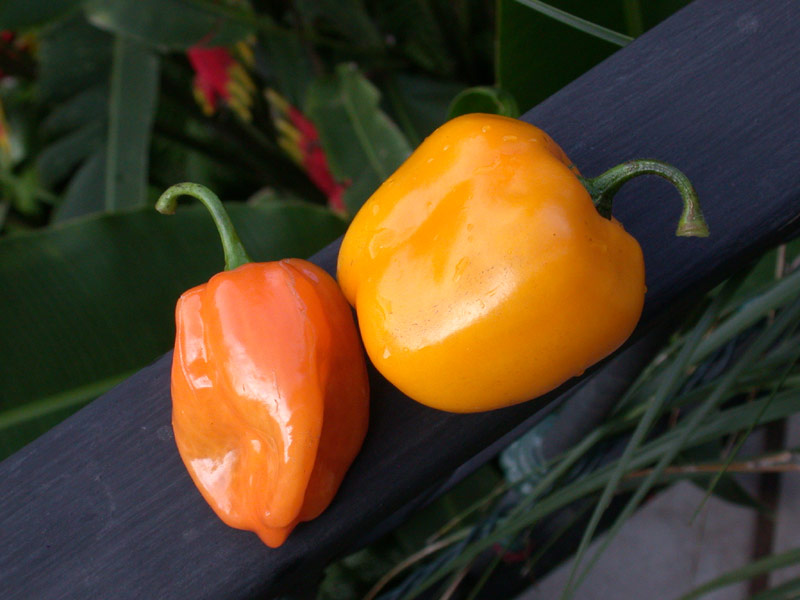
Chile habanero (left) and chile extranjero (right)
click here for a larger version

In a previous posting,
cascada post 8, I discussed the beautiful chile pepper (or chili pepper if you prefer that spelling) you see on the right in the picture above. Here locally, in Col. Ursulo Galvan, near Xico, in the state of Veracruz, Mexico, people call this chile "chile extranjero" which literally means "foreign chile". Apparently it originated in the Andes mountains of South America many millennia ago but was not introduced into Mexico until roughly 100 years ago.

The vast majority of chile peppers available in the USA are different varieties (or cultivars) of a single species: Capsicum annuum. The two chile peppers above are both unusual in that neither is Capsicum annuum. The chile habanero is Capsicum chinense (a misnomer since it is not of Chinese origin) and the chile extranjero is Capsicum pubescens. If it has
black seeds you know you have chile extranjero.

Both of these chiles (the habanero and the extranjero) are tasty but very hot. The interior part of the chile extranjero and the seeds are much hotter than the meaty part near the skin. Even just touching the seeds will cause your fingers to burn, even if you wash your hands. Be careful not to touch your eyes after cutting or preparing chile extranjero.

What I learned recently, which did not surprise me, is that 'chile extranjero' is just a local name. Here in the state of Veracruz the correct name is 'chile cera', which literally means 'wax chile'. In much of Mexico it called 'chile manzano' (apple chile), in the state of Oaxaca it is called 'chile canario' (canary chile, because it is yellow), and in the state of Michoacán it is called 'chile Perón'. Click on
this link for more information about Mexican chiles, and look under 'Chile Manzano' for more about chile extranjero, which from now on I will try to remember to call 'chile cera'.

Saturday, June 23, 2007

cascada post 18

Video of Cascada

Here you have it, short on quality, but it is my cascada -- the view from my front window.


My Cascada

And here you have Cascada at her worst:

Cascada, August 6, 2006

That's all for today.

Tuesday, May 22, 2007

cascada post 13

In the Xalapa Sculpture Garden -- Part 2

Here are more pictures of the Xalapa Sculpture Garden, taken back in July of 2005. The indoor pictures were part of a show, not part of the permanent pictures. My apologies to the artists (and to the readers) for the artists names that I did not record.


Mi nieto by Rocio Sagaon -- high temperature ceramics
(another view is in my previous Part 1 posting)


look carefully and you will see a daddy-long-legs spider


intermission -- garden flora
(photo by Esther)


made of bamboo


photo by Esther


photo by Esther


Thats all! If you want to see more, come and visit Xalapa and go to the Sculpture Garden.


Wednesday, February 28, 2007

cascada: contents for February, 2007

Monday, February 19, 2007

cascada post 7

Álamo Veracruz

There is a small town near the coast in the state of Veracruz, Mexico, called Álamo. The Internet says the population is 40,000 but to me it seemed smaller. You can see it on this map, near Tuxpan:


I really don't know much about the place, except that it seems to be the 'national capital' for oranges. My wife and I passed through there with Rita and Louie back in August, 2005, when driving back to Texas after a vacation in Xalapa. There is one incredible thing there in Álamo, and maybe more, but as I said we were just passing through. That is a huge concrete sculpture of a man emptying a large basket of oranges. Here is a picture just showing the oranges falling to the ground. Each orange is 2 to 3 feet in diameter and made of concrete.


Next is a picture looking up at the sculpture from underneath:


Next are a couple of pictures from further away which gives a better idea of the immense size:


Its really a shame how the electric wires and poles and signs obscure the view. On the other hand you wouldn't have believed how big it was.

Here is a detail of the oranges themselves. Remember, they are all made of concrete and 2 to 3 feet across:


concrete oranges 2 to 3 feet in diameter

Here are the guys that did it, inscribed on the basket of the sculpture itself, which you can see very small in the 'looking up' picture:


I need to find these guys because I would like to build some geometric sculptures (much simpler) myself, and I don't have a clue how to do it.

If you know about this kind of thing, or about Álamo, please chime in.

Saturday, February 10, 2007

cascada post 2


Beekeeping in La Mancha


We set out around 9:00 in the morning for La Mancha on the coast a bit north of Veracruz. We were with Norma, a young woman with boundless energy, Directora of Pronatura, a scuba diver, para-sailor and who knows what else. The project is to set up beekeeping and promote tourism. They were having a training class, and we were going mostly just to see La Mancha and the bees. First we went to Veracruz so Norma could return a wet suit at her friends scuba shop. I only took one picture there, this scene near the scuba shop.


Veracruz


Veracruz seemed pretty nice, at least downtown and near the wharf. Norma said there was a nice aquarium. We will definitely return to check it out.


We headed north on the coast highway and soon came to a vista overlooking the Laguna of La Mancha. Here is what we saw:


Laguna de la Mancha with the Gulf of Mexico in the distance.


We turned down the dirt road to La Mancha, which I thought would be a small town, but we never saw a town. Norma said there was one but that the whole area there was called 'La Mancha'. Presently we looked out the car window to the right and saw a field with several birds. Here are Ibis we saw:


Ibis


A little further along we could see Mangrove trees along the far edge of the Lagoon. Pretty soon we came to the Pronatura place which consisted of seven or eight large round thatch-roofed huts. Each had maybe eight fairly comfortable cots, electricity, and round windows covered with mosquito netting. These were for eco-tourists, but I wasn't sure if that was the plan or if it was operational already. There was also an older more rectangular building which was a kitchen.


About ten people, some Pronatura staff and a few students, were suiting up with white bee-protection gear. They were about to head to the hives and we walked there with them. It looked like this:


Pronatura bee hives at La Mancha


Here is how we looked:


Learning about bees. Esther is closest.


The guides were very knowledgeable and answered all our questions and explained much about bees. All was home made, including the smoke makers. Bees retreat from smoke. We were told that each hive might have as many as 30,000 bees.


Soon our bee excursion was over and we walked back to the Pronatura site where a wonderful fish lunch awaited us. Here are the people we ate with. Norma is on the far left and Esther on the far right :-).


Fish lunch


Here is my fish. The red is a tomato sauce. (Esther says the picture makes it look like blood.)


The fish I ate


After lunch, which in Mexico is the big meal of the day usually eaten around 2:00 or 3:00 p.m., we were entertained by Daniel, a friend of the instructor. Daniel played classical music for us, starting with selections from the 16th, 17th, 18th, 19th and 20th centuries. We all relaxed and listened in one of those round thatched-roofed huts. Here is Daniel:


Daniel, classical guitar


Norma, who was still energetic, then took Esther and me to the beach, where the La Mancha Lagoon meets the Gulf of Mexico. This was a couple of miles further down the road. There were some restaurants to one side in beach buildings with thatched roofs.


Restaurants at La Mancha beach


The beach itself looked like this:


La Mancha beach


La Mancha beach, another view


Walking in the sand back to Norma's car we saw these little guys busily cleaning house:


Sand crabs


Then we headed home, which took about an hour. And that is how we spent Sunday July 23, 2006.

Return to Mexico index of my homepage.

Return to my homepage.