Showing posts with label art. Show all posts

Monday, December 1, 2008

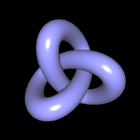
Trefoil from 2005

Playing with Maple back in May 2005 I found this pretty trefoil which I encountered again today digging through some backup CD's looking for something else. Hope you enjoy it.

May Trefoil
(click on image to see it larger)


Friday, November 28, 2008

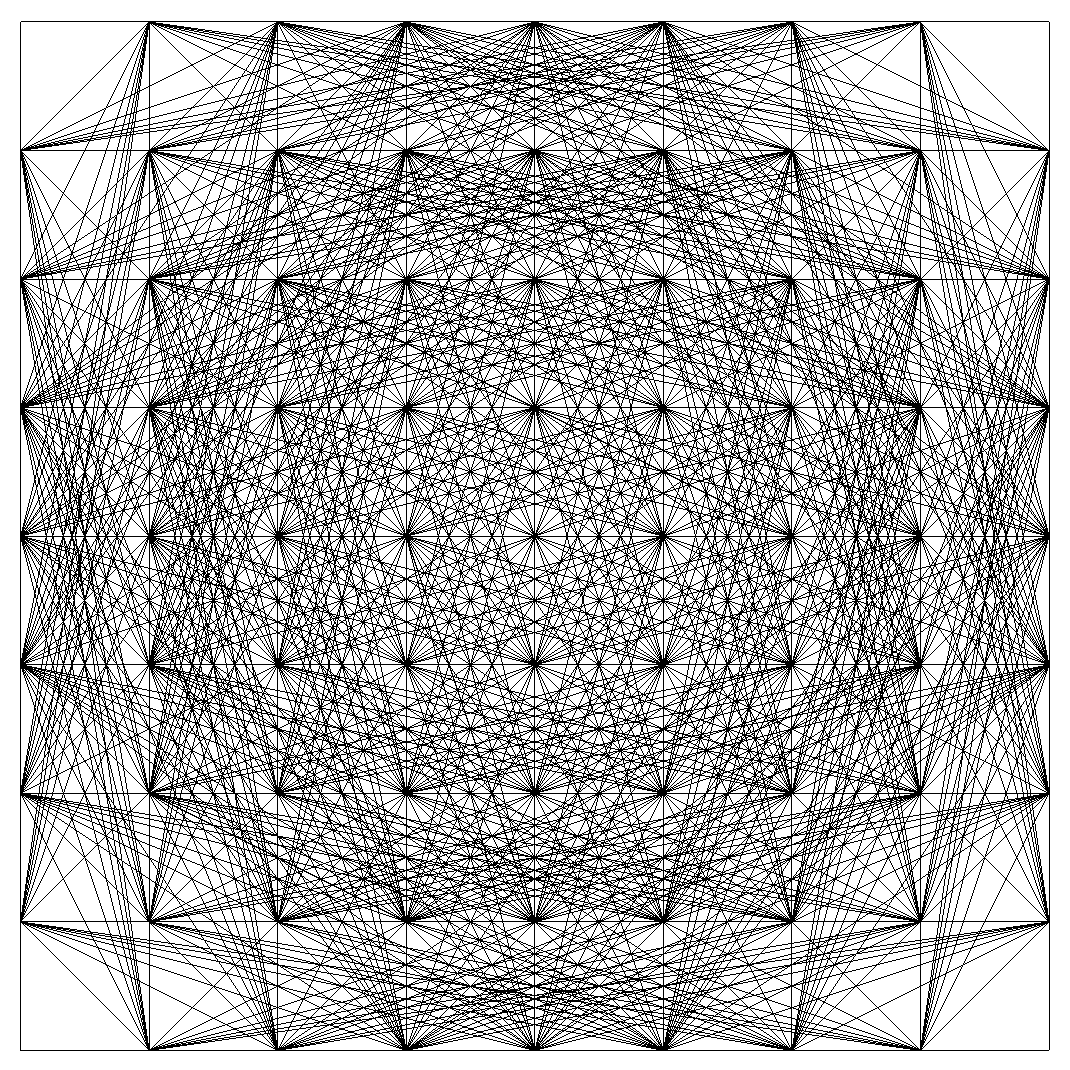
Squares on a grid

Over on Yahoo!Answers someone asked how many squares could be drawn on a 8 by 8 grid. I didn't have a clue so I wrote a program to generate them all and count as it went. The answer turned out to be 540. The image of all those squares is quite nice so I thought I would share it here:

Saturday, March 29, 2008

More Dog Art

In the labyrinths of lives and civilizations long past there were in Mexico and other parts of the Americas some who revered the dog. This first photo is a ceramic dog made perhaps 1900 years ago. I took the photo in a museum in Colima, Mexico in April of 2004. Probably it depicts a kind of hairless dog, known as the Techichi or Escuincle which is believed to be a relative of the Chihuahua and possibly also of the Mexican Hairless also called the Xoloitzcuintle. Apparently these dogs or their ceramic representations were sometimes buried with their masters, to guide on the long trip to another world.

Pre-Hispanic dog in Colima, Mexico

In Xalapa, capital of the state of Veracruz, in Mexico there is a wonderful museum of anthropology. I took the next two photos there in July, 2002. They are also prehispanic representations of dogs -- unfortunately I did not record the civilization or period they came from.

Ancient Mexican Dog

I wish I knew why this poor dog was hunched over and whether it was functional or ceremonial or decorative or what -- but I do not.

The next photo, also from the Museum of Anthropology in Xalapa, proves that the wheel was known in the Americas before Europeans came. Apparently this dog was a child's toy and so far as anyone knows the wheel was not used otherwise.

Prehispanic Mexican toy dog


On the edge of the city of Colima, in the state of Colima, Mexico is a wonderful statue of two dogs dancing. To me they seem to be kissing as well. Here is a photo I took of that statue in April, 2004:

Dancing Dogs -- Colima -- Mexico

These dogs are really quite large, maybe 6 or 8 feet tall, I wish I could remember better. They are modeled, I believe, after a much smaller archaeological find dating back to 150 AD approximately.

Back in August of 2003 I was in St. Louis for my daughter's wedding and had a chance to visit the St. Louis Art Museum. They allowed you to take no-flash-no-tripod photos then and I took a this picture of what I think is a well known painting of two sighthounds:

Two sighthounds. Artist = ???

Unfortunately I didn't write down the artist's name or the date of the painting. Please email me ( jbuddenh at gmail dot com) or comment if you have any information about this painting and I will update this blog entry.


The next image is a photo I took at the Texas Clay Festival in Gruene, Texas back in October, 2005. I don't remember the artist's name. Here it is:

Dog art at Texas Clay Festival, October, 2005
(ceramicist unknown )


By the way, I put 49 photos of the Texas Clay Festival of 2005 out on the internet and they are still there, just photos, no text. To see them click here.

In the year 2004 my wife and I drove across the United States and spent a couple of days in the Silver City, New Mexico area. We heard there would be a festival called "Fiesta de la Olla" in the small mountain town of Pinos Altos near the 7080 ft high continental divide north of Silver City. This festival celebrates (among other things) the wonderfully decorated Mexican pottery made in the village of Mata Ortiz, Chihuahua, Mexico. So we went to see the fiesta and I took some photos including this one which should give you an idea of the Mata Ortiz pottery:

Mata Ortiz pottery

Later we wandered a bit around the town and I came across this wonderful sculpture of a dog in someone's yard:

Folk Art, Pinos Altos, New Mexico (July 17, 2004)


Some of you, like me, may be old enough to remember when the Soviet Union shot off Sputnik 1 on October 4, 1957. This was the first artificial satellite to orbit the earth and it shocked the U.S. out of the complacent feeling that we were the most technologically sophisticated nation on earth. It precipitated changes in the teaching of science and mathematics and was surely one of reasons for John F. Kennedy's 1961 decision to put a man on the moon. You may also remember that Sputnik 1 was unmanned but that shortly thereafter on November 3, 1957, the Soviet Union put the first 'astronaut' into space and that astronaut was a dog named Laika (original name кудрявка). That poor dog met a terrible fate. At least we have this painting (which I snagged from some commercial site, if memory serves) to remember her by:

Laika the Space Dog


My next dog art image is by Irish printmaker Tim Mara(1948-1997) and is one of my favorites. One Tim Mara site said that images can be used 'for educational purposes only', so I hereby declare this an educational blog. Here is the image:

A print of Tim Mara


Last (and in some sense least :)) let me conclude this dog art post with a painting of the well known Colombian artist Fernando Botero (born 1932):

Dog Turning a Corner -- Fernando Botero--1980

This concludes today's posting on dog art. Since my collection has swollen to over 250 images, I reserve the right to someday post again on this topic.

Tuesday, November 13, 2007

cascada post 24

Dog Art

I know. The title should say 'The Dog in Art'. If you came here looking for dog art I apologize. But this title is surely more of a lure. My file of art pictures with dogs now has about 125 pictures, so I thought I would share a few and maybe more another time. Most of these pictures have been on my computer for a long time. Some came from usenet and others from web sites and I really didn't keep track. If you see something that is 'yours' and you want me to remove it or provide a link to your site containing it, please let me know.

First is a detail from a 16th century Korean art piece attributed to Yi Am, 1499-1566.

Dog with feather (detail) -- 16th century, Korean
Attributed to Yi Am, 1499-1566


Picasso apparently liked dogs. At any rate I have seen several photographs of Picasso with dogs. Here is a Picasso painting with a dog from his 'blue period'.

Boy with Dog -- Picasso -- 1905


Next is a curious painting of Charles Christian Nahl (1818-1878) who was born and studied art in Germany, moved to Paris in 1846 where he exhibited in the Paris Salon. To escape the French revolution he moved the United States and ultimately went to California during the 'gold rush'. Not finding gold he opened a studio in Sacramento and later moved to San Francisco.

Sacramento Indian with Dogs -- Charles Christian Nahl -- 1867
(see it large )

Charles Christian Nahl did lots of commission work to support himself, including designing the Grizzly Bear that appears on the California state flag. He ultimately died in San Francisco of typhoid fever in 1878.

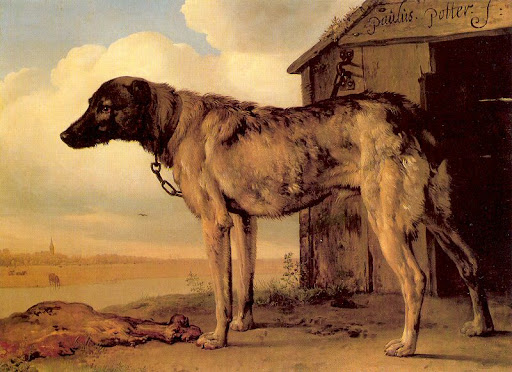
The next image is by Paulus Potter was a Dutch painter in the period of the 'Dutch Golden Age' who specialized in painting landscapes with animals. He was born in 1625 and died of tuberculosis at the young age of 28, in 1654. In spite of such an early demise he painted over 100 paintings and this one is truly a portrait.


The Wolfhound -- Paulus Potter -- 1650-52
(see it larger )

There is a sad dog that roams our neighborhood here in Mexico that looks a lot like Potter's wolfhound. Someday I'll get a picture of it.

The famous Mexican artist Rufino Tamayo (1899 – 1991) made several images featuring dogs. This one is called 'Perro Aullando' (Howling Dog).

Perro Aullando -- Rufino Tamayo -- 1960


I'm not sure if the black disk in the background, with the faint image inside it, is supposed to be the moon or the sun or what. Nor do I know why it is black. In any case this picture could just as well be in one of my 'art circles' posts!

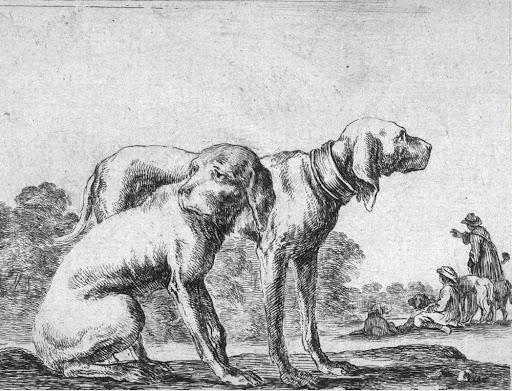
Next is a detail from an etching of Italian printmaker Stefano della Bella (1610 - 1664).

Two Hunting Dogs (detail) -- Stefano della Bella -- 1641
(see it larger)

Acclaimed contemporary artist Lucian Michael Freud was born in Berlin in 1922, a grandson of Sigmund Freud. When about 11 years old, he moved with his parents to London to escape Nazi Germany. Here are two interesting paintings of Lucian Freud with dogs as important parts of their subject matter. I especially like this next image, partly because the dog reminds me a lot of our strange dog Cosi.

Eli and David -- Lucian Freud -- 2005-6

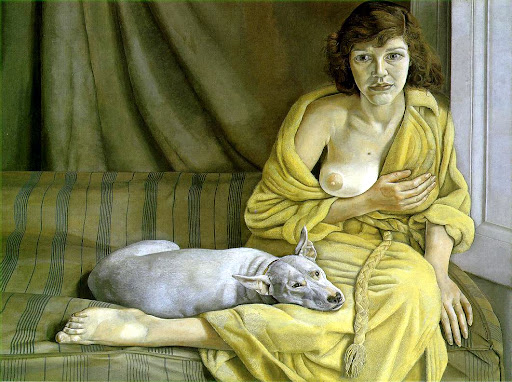
The next (and last) image is, I think, quite familiar. It is called 'Girl with a White Dog' but the subject is Freud's first wife, Kathleen Garman.

Girl with a White Dog -- Lucian Freud -- 1951-52
(see it larger)

Why her right breast is exposed, I have no idea -- especially since the white dog is already such an interesting subject!

Friday, September 28, 2007

cascada post 22

Art Circles -- Part 2

Recently I learned that 'tondo' a shortening of the Italian 'rotondo' i.e. 'round' is the word used in the art world for round paintings as shown in my last post. Today let me move temporarily away from tondos and show some interesting art involving circles in which the paintings are not circular. First is a painting by Arthur Dove (1880-1946), arguably the first American abstract painter. Here it is:


Arthur Dove, 'Red Sun', 1935

I really like that large red sun, at once a natural object, a three dimensional spiral, and a symbol. The muted red stripes in the foreground seem agricultural. The image is both austere and yet warm. Even the artists signature in the lower middle seems part of the composition.

The next image is a painting of Chagall. I am not sure I can put into words why I find it compelling. Stare at it a bit, because it will just have to speak for itself.


Chagall, 'Compostion aux Cercles et à la Chèvre', 1920


Next is a strange glowing circle in a sort-of landscape by Christopher Orr. I hope you like it.


Christopher Orr, Untitled (Circle), 2006

Christopher Orr is a contemporary artist, born in 1967. You can find more about him, and see more of his work, by looking at his CV at IBID PROJECTS, London.

Now, let us step back two millennia and compare Christopher Orr's painting with this image on a classical Greek bowl:


Classical Greek Ceramic Work, 2000 or more years ago

There is a similarity in that both images feature a man seemingly enamored with a circle. In the first image the man seems amazed that he can make a circle of light with his finger, while perhaps in the Greek image the man is simply enjoying the pleasure of rolling a hoop. Certainly I do not know. Perhaps a more knowledgeable person can explain the symbolism, if any, of the circle. The rooster in the Greek image is the symbolic gift of love, or perhaps more often an offer understood to imply a desire for sex. But, in this case, there is no other person in the image. I still have to wonder if Orr might have been influenced by this or some similar Greek image from another era.
For today's last image let us move forward, past the Renaissance, to the Dutch Golden Age and examine this self-portrait of Rembrandt in older age:


Rembrandt, 'Self-Portrait with two Circles', 1665-1669

I think the circles add something important to the picture. Without them the painting would be much less interesting.

This series of circles in art will be continued in some future postings.

Thursday, September 27, 2007

cascada post 21

Art Circles

For a while now I have been collecting images of art in which circles played an important role. My collection now has over 350 images, mostly snagged from the Internet, some from Usenet groups, a few from photos I took, a few from things I scanned or created. For the most part I know little of the artists. Still I thought it would be fun to share some of these images and in some cases say something about the artists who created them. In the beginning I set myself some ground rules, such as no crop circles, no religious paintings in which a large halo around someone's head is the circle, no mandalas, no spheres or 3D sculptures, no plates or bowls, no manhole covers, no large moons or suns, no coins or medallions, no amazingly circular breasts, etc. In the end I occasionally broke many of my self imposed rules and just saved what caught my fancy. So it will be a little of everything that you see here, but always involving a circle in some way. Some of the artists are famous and some are nearly unknown, and perhaps some (for example me) are not even artists.

Let me start with Banksy's dictum. Banksy, as you may know is a famous (or infamous) graffiti artist many of whose works you can find on walls or buildings in London and elsewhere. His homepage with many interesting images you can find here
. Next, as one of his pieces of 'art', is his dictum:

banksy's dictum

Mind you, I am not arguing that this is one of Banksy's better pieces -- in fact it may be self-refutational -- but it was an easy lead-in for this article. So far as I know, Banksy mostly did not follow his own advice. I have only seen one of his other pieces that featured a circle. It is a sort of modern day Iwo Jima image with a political statement, but not particularly noteworthy otherwise, so I won't show it here.

Following this idea let me first show you some art pieces which, it seems to me, are rather arbitrarily framed by a circle. The circle in these cases does not seem to have much to do with the art other than to frame it. Let us start with the early Renaissance artist Botticelli (1445-1510). He is most often known as Sandro Botticelli, but his original name was Alessandro di Mariano Filipepi. Most of his life was spent in Florence, Italy. Probably his most famous work is Birth of Venus (c. 1485). Here we see a circular painting by Botticelli in which the Virgin offers her breast to the Christ Child:


Botticelli, 'The Madonna and Child with Three Angels', 1493

Notice that the hands of the angels at the left and right are chopped off by the circular frame and the base of the ceramic at the bottom is also truncated. It seems unlikely that Botticelli would have painted it that way. It seems more likely that a circular frame was imposed on a larger painting, maybe even a rectangular one. However, I have seen a digital version of this painting where noticeably more of the angles hands were visible, so this version has most likely been digitally cropped to a slightly smaller circle. Compare this with another of Botticelli's circular paintings:


Botticelli, 'Madonna of the magnificat', c 1485 (diameter 118 cm)

In this tranquil, peaceful painting the arcs above the crown and the leaning figure on the left suggest that Botticelli intended a circular frame. The bisected hand at the left may indicate that the circular diameter was a little smaller than Botticelli expected or wanted.

Botticelli's work, in addition to religious paintings like the above, includes many depictions of classical Greek mythology and many wonderful portraits of the powerful Medici family. The vast majority of his work is not framed by circles.

The next painting is by the Dutch artist Jan van Goyen (1596-1656) who painted mostly landscapes in the Netherlands and in Germany.


Jan van Goyen, 'Summer', 1625, diameter 33.5 cm

I downloaded this image from a usenet group a few years ago. A larger version (1600x1600 pixels, 400k bytes) can be found at the Rijksmuseum in Amsterdam. It is well worth clicking here to see the large version. A second Goyen circular painting is entitled 'winter'. Here it is:


Jan van Goyen, 'Winter', 1625

In the second image parts of the black diamond (or tilted square) shaped frame can be seen, insuring that the full extent of the circular painting is visible. The people seem to be carefully arranged to fit in this circular frame so Goyen must have consciously designed the piece for a circular frame. The circular frame does not seem to serve any artistic purpose, other than perhaps giving one the illusion of looking through a circular window or perhaps through a telescope, since low power telescopes were readily available in the Netherlands at the time this picture was painted. See here for an interesting history of the telescope. I do not know if Goyen made paintings for 'Autumn' or 'Spring'. Certainly most of his over 1200 paintings and 800 drawings were not circular.

Now let us jump to the year 1740, where we find this wonderful painting by the Dutch artist Jacob de Wit. Yes, it looks 3D, like maybe it is made out of plaster. But that is not the case. It is a painting. The children may be playing with fire, but they are also keeping warm in the winter.


Painting by Jacob de Wit, 1740

Now here is a curve ball for you:


Picasso, 'Nature morte à la chaise cannée', 1911-12 **

**
You are right if you are saying 'wait a minute', because, so far as I know Picasso did not paint any circular pictures. The original of the above is elliptical and you may well like it better. It should be easy to find using google image search. Still, the circular version above, which I created using Irfanview, doesn't look too bad. The rope and the cane are not painted -- at least I don't think they are -- as this is a multi-media picture.

I will continue with more 'art circles' in a future posting, and I will include non-circular pictures in which the circle plays an important role.

Monday, June 11, 2007

cascada post 15

The Scream You Didn't Hear


Edvard Munch, the Norwegian painter was born near Olso, then Christiania, in 1863. At that time the United States was in the middle of its Civil War, and Sweden and Norway were united, albeit with stresses. Munch was to see his mother die when he was five, and his favorite sister a year older than him, when he was 14. Both died of tuberculosis. It seems his life was filled with struggle and he once said "Sickness, insanity, and death were the angels that surrounded my cradle and they have followed me throughout my life." So perhaps it is not surprising that his most famous painting, The Scream, painted in 1893 is full of psychological torment.

The Scream, by Edvard Munch, 1893


I once thought there was just one scream, and was perturbed when I learned a few years ago that it was stolen. In fact at Munch made at least 50 versions of The Scream including lithographs. Two different versions were stolen, one in 1994 the other in 2004.

Munch described the circumstances which led to the scream as follows:

"I was walking along a path with two friends – the sun was setting – suddenly the sky turned blood red – I paused, feeling exhausted, and leaned on the fence – there were blood and tongues of fire above the blue-black fjord and the city – my friends walked on, and I stood there trembling with anxiety – and I sensed an infinite scream passing through nature."

So the figure depicts Munch himself, but it was not he who screamed, rather the picture depicts fear, angst and panic and the desire to escape it. Some believe that the red skies are real because the recent eruption of the Indonesian volcano Krakatoa caused intense sunsets throughout the world at about that time.

The 2004 theft included also this Munch painting, about which I know very little:

Madonna, by Edvard Munch, 1894-95

Both paintings were recovered in 2006, but were significantly damaged.

When I recently read that one Munch painting caused a scandal and that people demanded that his show be taken down, I thought it must have been his Madonna since it is a surprisingly sensuous Virgin painting (if, in fact, that is what it is), especially for one painted in the nineteenth century. But no, the painting which caused the scandal was this one:


The Sick Child, by Edvard Munch, 1886

It was in Berlin in 1892 and the show was taken down and the art was called degenerate. Apparently, the art critics of Berlin at the time were conservative and expected realistic, natural, and perhaps formal art. Pieces such as the The Sick Child and some others in the show seemed unfinished, and unprofessional with the surface scratched and some paint scraped off in places. Although the mood evoked was reminiscent of Munch's sick and dying sister, a sort of "psychological realism", it was interpreted as at best disrespectful if not outrightly provocative and anarchistic. In fact Munch was closely connected to the bohemian group Kristianiabohêmen and a good friend of one of its key members, Hans Jæger, writer, philosopher, and political activist, and ribald anarchist.


Hans Jæger, by Edvard Munch, 1896

The paradoxical consequence of Munch's 'scandalous show' was immediate notoriety which Munch was able to parlay into new shows and commissions.

In this next painting Munch portrays his family in the sickroom with his dying sister, seated.


Death in the Sickroom, by Edvard Munch, 1893

Below, in no particular order, are several more pieces by Munch.


Ashes, by Edvard Munch, 1894


Dr. Linde's sons, by Edvard Munch, 1904


The Flower of Pain, woodcut by Edvard Munch, 1898


In Munch's troubled life he suffered at times from over indulgence with alcohol, with insomnia, and with depression. Still, he had several relationships with women, who apparently pursued him more than he pursued them. The most noteworthy was with Tulla Larsen whom he met in 1898. Her ardor and desire for marriage exceeded his and their relationship came to a dramatic end in 1902 in an incident in which he (apparently), either accidentally or purposefully shot himself in the left hand. The next painting is usually interpreted to reflect this incident, although, the name refers to a same-named work of Jacques Louis David (1748–1825).

Death of Marat I, by Edvard Munch, 1907

We end with three Munch self portraits:

Self Portrait with a Cigarette, by Edvard Munch, 1895


Self Portrait with a Bottle of Wine, by Edvard Munch, 1906


self portrait, The Night Wanderer, by Edvard Munch, 1923-24

It is worth pondering, I think, some of Munch's own words:

‘Whether the picture resembles nature or not is irrelevant, as a picture cannot be explained;
the reason for its being painted in the first place was that the artist could find no other means
of expressing what he saw. The finished work can only give a hint of what was in the artist’s mind.’

‘The camera will never compete with the brush and the palette, until such time as photographs
can be taken in Heaven or Hell.’

‘In my art I have tried to find an explanation for life and to discover its meaning.
I also intended to help others understand life.’
As old age approached Munch became increasingly isolated. He remained productive and eventually donated his voluminous collection of personal work to the city of Oslo.

At the time of his death in 1944, Norway, his homeland, was still in the grips of the Nazis. And I was 6 months old!

If you endured this far, but found this posting a little heavy, you might want to try this obliquely related link, which is billed as a brainteaser but is more of an optical thing where you stare at a picture for about a minute, until you 'get it'. Click here to try it.

Tuesday, May 22, 2007

cascada post 13

In the Xalapa Sculpture Garden -- Part 2

Here are more pictures of the Xalapa Sculpture Garden, taken back in July of 2005. The indoor pictures were part of a show, not part of the permanent pictures. My apologies to the artists (and to the readers) for the artists names that I did not record.


Mi nieto by Rocio Sagaon -- high temperature ceramics
(another view is in my previous Part 1 posting)


look carefully and you will see a daddy-long-legs spider


intermission -- garden flora
(photo by Esther)


made of bamboo


photo by Esther


photo by Esther


Thats all! If you want to see more, come and visit Xalapa and go to the Sculpture Garden.