Showing posts with label Picasso. Show all posts

Tuesday, November 13, 2007

cascada post 24

Dog Art

I know. The title should say 'The Dog in Art'. If you came here looking for dog art I apologize. But this title is surely more of a lure. My file of art pictures with dogs now has about 125 pictures, so I thought I would share a few and maybe more another time. Most of these pictures have been on my computer for a long time. Some came from usenet and others from web sites and I really didn't keep track. If you see something that is 'yours' and you want me to remove it or provide a link to your site containing it, please let me know.

First is a detail from a 16th century Korean art piece attributed to Yi Am, 1499-1566.

Dog with feather (detail) -- 16th century, Korean
Attributed to Yi Am, 1499-1566


Picasso apparently liked dogs. At any rate I have seen several photographs of Picasso with dogs. Here is a Picasso painting with a dog from his 'blue period'.

Boy with Dog -- Picasso -- 1905


Next is a curious painting of Charles Christian Nahl (1818-1878) who was born and studied art in Germany, moved to Paris in 1846 where he exhibited in the Paris Salon. To escape the French revolution he moved the United States and ultimately went to California during the 'gold rush'. Not finding gold he opened a studio in Sacramento and later moved to San Francisco.

Sacramento Indian with Dogs -- Charles Christian Nahl -- 1867
(see it large )

Charles Christian Nahl did lots of commission work to support himself, including designing the Grizzly Bear that appears on the California state flag. He ultimately died in San Francisco of typhoid fever in 1878.

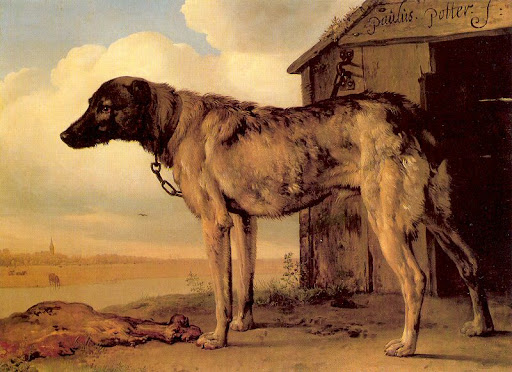
The next image is by Paulus Potter was a Dutch painter in the period of the 'Dutch Golden Age' who specialized in painting landscapes with animals. He was born in 1625 and died of tuberculosis at the young age of 28, in 1654. In spite of such an early demise he painted over 100 paintings and this one is truly a portrait.


The Wolfhound -- Paulus Potter -- 1650-52
(see it larger )

There is a sad dog that roams our neighborhood here in Mexico that looks a lot like Potter's wolfhound. Someday I'll get a picture of it.

The famous Mexican artist Rufino Tamayo (1899 – 1991) made several images featuring dogs. This one is called 'Perro Aullando' (Howling Dog).

Perro Aullando -- Rufino Tamayo -- 1960


I'm not sure if the black disk in the background, with the faint image inside it, is supposed to be the moon or the sun or what. Nor do I know why it is black. In any case this picture could just as well be in one of my 'art circles' posts!

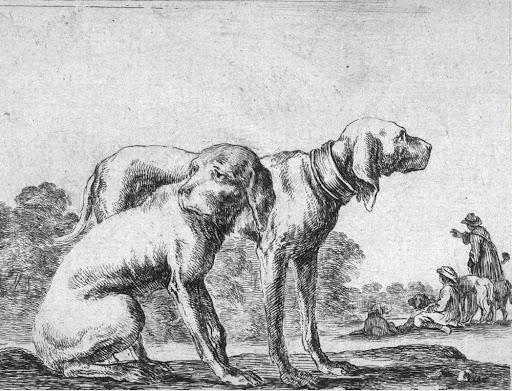
Next is a detail from an etching of Italian printmaker Stefano della Bella (1610 - 1664).

Two Hunting Dogs (detail) -- Stefano della Bella -- 1641
(see it larger)

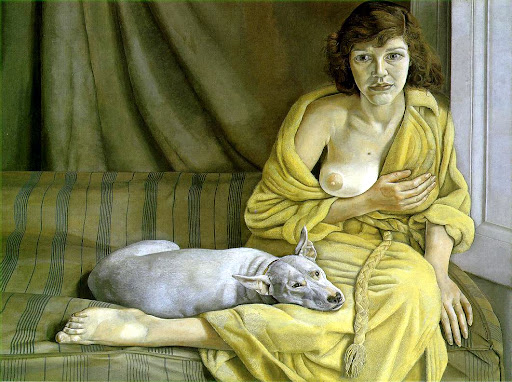
Acclaimed contemporary artist Lucian Michael Freud was born in Berlin in 1922, a grandson of Sigmund Freud. When about 11 years old, he moved with his parents to London to escape Nazi Germany. Here are two interesting paintings of Lucian Freud with dogs as important parts of their subject matter. I especially like this next image, partly because the dog reminds me a lot of our strange dog Cosi.

Eli and David -- Lucian Freud -- 2005-6

The next (and last) image is, I think, quite familiar. It is called 'Girl with a White Dog' but the subject is Freud's first wife, Kathleen Garman.

Girl with a White Dog -- Lucian Freud -- 1951-52
(see it larger)

Why her right breast is exposed, I have no idea -- especially since the white dog is already such an interesting subject!

Thursday, September 27, 2007

cascada post 21

Art Circles

For a while now I have been collecting images of art in which circles played an important role. My collection now has over 350 images, mostly snagged from the Internet, some from Usenet groups, a few from photos I took, a few from things I scanned or created. For the most part I know little of the artists. Still I thought it would be fun to share some of these images and in some cases say something about the artists who created them. In the beginning I set myself some ground rules, such as no crop circles, no religious paintings in which a large halo around someone's head is the circle, no mandalas, no spheres or 3D sculptures, no plates or bowls, no manhole covers, no large moons or suns, no coins or medallions, no amazingly circular breasts, etc. In the end I occasionally broke many of my self imposed rules and just saved what caught my fancy. So it will be a little of everything that you see here, but always involving a circle in some way. Some of the artists are famous and some are nearly unknown, and perhaps some (for example me) are not even artists.

Let me start with Banksy's dictum. Banksy, as you may know is a famous (or infamous) graffiti artist many of whose works you can find on walls or buildings in London and elsewhere. His homepage with many interesting images you can find here
. Next, as one of his pieces of 'art', is his dictum:

banksy's dictum

Mind you, I am not arguing that this is one of Banksy's better pieces -- in fact it may be self-refutational -- but it was an easy lead-in for this article. So far as I know, Banksy mostly did not follow his own advice. I have only seen one of his other pieces that featured a circle. It is a sort of modern day Iwo Jima image with a political statement, but not particularly noteworthy otherwise, so I won't show it here.

Following this idea let me first show you some art pieces which, it seems to me, are rather arbitrarily framed by a circle. The circle in these cases does not seem to have much to do with the art other than to frame it. Let us start with the early Renaissance artist Botticelli (1445-1510). He is most often known as Sandro Botticelli, but his original name was Alessandro di Mariano Filipepi. Most of his life was spent in Florence, Italy. Probably his most famous work is Birth of Venus (c. 1485). Here we see a circular painting by Botticelli in which the Virgin offers her breast to the Christ Child:


Botticelli, 'The Madonna and Child with Three Angels', 1493

Notice that the hands of the angels at the left and right are chopped off by the circular frame and the base of the ceramic at the bottom is also truncated. It seems unlikely that Botticelli would have painted it that way. It seems more likely that a circular frame was imposed on a larger painting, maybe even a rectangular one. However, I have seen a digital version of this painting where noticeably more of the angles hands were visible, so this version has most likely been digitally cropped to a slightly smaller circle. Compare this with another of Botticelli's circular paintings:


Botticelli, 'Madonna of the magnificat', c 1485 (diameter 118 cm)

In this tranquil, peaceful painting the arcs above the crown and the leaning figure on the left suggest that Botticelli intended a circular frame. The bisected hand at the left may indicate that the circular diameter was a little smaller than Botticelli expected or wanted.

Botticelli's work, in addition to religious paintings like the above, includes many depictions of classical Greek mythology and many wonderful portraits of the powerful Medici family. The vast majority of his work is not framed by circles.

The next painting is by the Dutch artist Jan van Goyen (1596-1656) who painted mostly landscapes in the Netherlands and in Germany.


Jan van Goyen, 'Summer', 1625, diameter 33.5 cm

I downloaded this image from a usenet group a few years ago. A larger version (1600x1600 pixels, 400k bytes) can be found at the Rijksmuseum in Amsterdam. It is well worth clicking here to see the large version. A second Goyen circular painting is entitled 'winter'. Here it is:


Jan van Goyen, 'Winter', 1625

In the second image parts of the black diamond (or tilted square) shaped frame can be seen, insuring that the full extent of the circular painting is visible. The people seem to be carefully arranged to fit in this circular frame so Goyen must have consciously designed the piece for a circular frame. The circular frame does not seem to serve any artistic purpose, other than perhaps giving one the illusion of looking through a circular window or perhaps through a telescope, since low power telescopes were readily available in the Netherlands at the time this picture was painted. See here for an interesting history of the telescope. I do not know if Goyen made paintings for 'Autumn' or 'Spring'. Certainly most of his over 1200 paintings and 800 drawings were not circular.

Now let us jump to the year 1740, where we find this wonderful painting by the Dutch artist Jacob de Wit. Yes, it looks 3D, like maybe it is made out of plaster. But that is not the case. It is a painting. The children may be playing with fire, but they are also keeping warm in the winter.


Painting by Jacob de Wit, 1740

Now here is a curve ball for you:


Picasso, 'Nature morte à la chaise cannée', 1911-12 **

**
You are right if you are saying 'wait a minute', because, so far as I know Picasso did not paint any circular pictures. The original of the above is elliptical and you may well like it better. It should be easy to find using google image search. Still, the circular version above, which I created using Irfanview, doesn't look too bad. The rope and the cane are not painted -- at least I don't think they are -- as this is a multi-media picture.

I will continue with more 'art circles' in a future posting, and I will include non-circular pictures in which the circle plays an important role.