Thursday, September 27, 2007

cascada post 21

Art Circles

For a while now I have been collecting images of art in which circles played an important role. My collection now has over 350 images, mostly snagged from the Internet, some from Usenet groups, a few from photos I took, a few from things I scanned or created. For the most part I know little of the artists. Still I thought it would be fun to share some of these images and in some cases say something about the artists who created them. In the beginning I set myself some ground rules, such as no crop circles, no religious paintings in which a large halo around someone's head is the circle, no mandalas, no spheres or 3D sculptures, no plates or bowls, no manhole covers, no large moons or suns, no coins or medallions, no amazingly circular breasts, etc. In the end I occasionally broke many of my self imposed rules and just saved what caught my fancy. So it will be a little of everything that you see here, but always involving a circle in some way. Some of the artists are famous and some are nearly unknown, and perhaps some (for example me) are not even artists.

Let me start with Banksy's dictum. Banksy, as you may know is a famous (or infamous) graffiti artist many of whose works you can find on walls or buildings in London and elsewhere. His homepage with many interesting images you can find here
. Next, as one of his pieces of 'art', is his dictum:

banksy's dictum

Mind you, I am not arguing that this is one of Banksy's better pieces -- in fact it may be self-refutational -- but it was an easy lead-in for this article. So far as I know, Banksy mostly did not follow his own advice. I have only seen one of his other pieces that featured a circle. It is a sort of modern day Iwo Jima image with a political statement, but not particularly noteworthy otherwise, so I won't show it here.

Following this idea let me first show you some art pieces which, it seems to me, are rather arbitrarily framed by a circle. The circle in these cases does not seem to have much to do with the art other than to frame it. Let us start with the early Renaissance artist Botticelli (1445-1510). He is most often known as Sandro Botticelli, but his original name was Alessandro di Mariano Filipepi. Most of his life was spent in Florence, Italy. Probably his most famous work is Birth of Venus (c. 1485). Here we see a circular painting by Botticelli in which the Virgin offers her breast to the Christ Child:


Botticelli, 'The Madonna and Child with Three Angels', 1493

Notice that the hands of the angels at the left and right are chopped off by the circular frame and the base of the ceramic at the bottom is also truncated. It seems unlikely that Botticelli would have painted it that way. It seems more likely that a circular frame was imposed on a larger painting, maybe even a rectangular one. However, I have seen a digital version of this painting where noticeably more of the angles hands were visible, so this version has most likely been digitally cropped to a slightly smaller circle. Compare this with another of Botticelli's circular paintings:


Botticelli, 'Madonna of the magnificat', c 1485 (diameter 118 cm)

In this tranquil, peaceful painting the arcs above the crown and the leaning figure on the left suggest that Botticelli intended a circular frame. The bisected hand at the left may indicate that the circular diameter was a little smaller than Botticelli expected or wanted.

Botticelli's work, in addition to religious paintings like the above, includes many depictions of classical Greek mythology and many wonderful portraits of the powerful Medici family. The vast majority of his work is not framed by circles.

The next painting is by the Dutch artist Jan van Goyen (1596-1656) who painted mostly landscapes in the Netherlands and in Germany.


Jan van Goyen, 'Summer', 1625, diameter 33.5 cm

I downloaded this image from a usenet group a few years ago. A larger version (1600x1600 pixels, 400k bytes) can be found at the Rijksmuseum in Amsterdam. It is well worth clicking here to see the large version. A second Goyen circular painting is entitled 'winter'. Here it is:


Jan van Goyen, 'Winter', 1625

In the second image parts of the black diamond (or tilted square) shaped frame can be seen, insuring that the full extent of the circular painting is visible. The people seem to be carefully arranged to fit in this circular frame so Goyen must have consciously designed the piece for a circular frame. The circular frame does not seem to serve any artistic purpose, other than perhaps giving one the illusion of looking through a circular window or perhaps through a telescope, since low power telescopes were readily available in the Netherlands at the time this picture was painted. See here for an interesting history of the telescope. I do not know if Goyen made paintings for 'Autumn' or 'Spring'. Certainly most of his over 1200 paintings and 800 drawings were not circular.

Now let us jump to the year 1740, where we find this wonderful painting by the Dutch artist Jacob de Wit. Yes, it looks 3D, like maybe it is made out of plaster. But that is not the case. It is a painting. The children may be playing with fire, but they are also keeping warm in the winter.


Painting by Jacob de Wit, 1740

Now here is a curve ball for you:


Picasso, 'Nature morte à la chaise cannée', 1911-12 **

**
You are right if you are saying 'wait a minute', because, so far as I know Picasso did not paint any circular pictures. The original of the above is elliptical and you may well like it better. It should be easy to find using google image search. Still, the circular version above, which I created using Irfanview, doesn't look too bad. The rope and the cane are not painted -- at least I don't think they are -- as this is a multi-media picture.

I will continue with more 'art circles' in a future posting, and I will include non-circular pictures in which the circle plays an important role.

Tuesday, August 14, 2007

cascada post 20

Chile Extranjero Update

chile portrait
Chile habanero (left) and chile extranjero (right)
click here for a larger version

In a previous posting,
cascada post 8, I discussed the beautiful chile pepper (or chili pepper if you prefer that spelling) you see on the right in the picture above. Here locally, in Col. Ursulo Galvan, near Xico, in the state of Veracruz, Mexico, people call this chile "chile extranjero" which literally means "foreign chile". Apparently it originated in the Andes mountains of South America many millennia ago but was not introduced into Mexico until roughly 100 years ago.
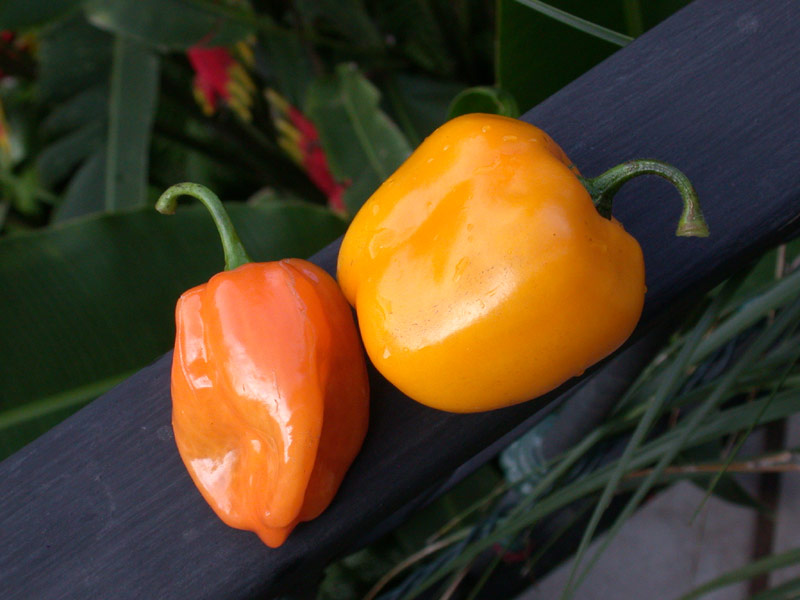
The vast majority of chile peppers available in the USA are different varieties (or cultivars) of a single species: Capsicum annuum. The two chile peppers above are both unusual in that neither is Capsicum annuum. The chile habanero is Capsicum chinense (a misnomer since it is not of Chinese origin) and the chile extranjero is Capsicum pubescens. If it has
black seeds you know you have chile extranjero.

Both of these chiles (the habanero and the extranjero) are tasty but very hot. The interior part of the chile extranjero and the seeds are much hotter than the meaty part near the skin. Even just touching the seeds will cause your fingers to burn, even if you wash your hands. Be careful not to touch your eyes after cutting or preparing chile extranjero.

What I learned recently, which did not surprise me, is that 'chile extranjero' is just a local name. Here in the state of Veracruz the correct name is 'chile cera', which literally means 'wax chile'. In much of Mexico it called 'chile manzano' (apple chile), in the state of Oaxaca it is called 'chile canario' (canary chile, because it is yellow), and in the state of Michoacán it is called 'chile Perón'. Click on
this link for more information about Mexican chiles, and look under 'Chile Manzano' for more about chile extranjero, which from now on I will try to remember to call 'chile cera'.

Friday, July 6, 2007

cascada post 19

Col. Ursulo Galvan
Niños y Niñas

Colonia Ursolo Galvan is the name of the small town where I live. It is a small place, maybe 1000 people, about a mile or so off the main road, roughly halfway between Coatepec and Xico, in the state of Veracruz, Mexico. The 'Colonia' part of the name is because it is a 'Colonia' of Xico. This means that officially it is in the municipality of Xico, even though it is about three miles from the population edge of Xico. It is a peaceful, friendly, and generally nice place to live although is quite poor. Most people do not have cars, most cook on wood fires, and some have dirt floors. Still, there is community pride, and family pride, and pride in the state of Veracruz. There are lots of children here and they are, compared to many kids in the U.S., well behaved. They often play in the streets, and save for buses there is little traffic and it is safe. The picture (above left) shows about one third of the town.

When I first arrived here I was surprised to learn that this little town has four schools. One is a preschool which seems to have two or three levels, roughly like kindergarden and pre-kindergarden. There are two primary schools, and a secondary school called a 'Telebachillerato', roughly like a high school in the U.S. but much of the instruction is piped in via satellite TV. This seems to be fairly common in rural parts of Mexico.


Our friend Marie dropped by one day to invite us to attend Daniela's end of school celebration. Daniela (or Dani) is her preschool daughter, about four years old. At left is a picture of Dani, from about a year ago. That is a really serious pose. She is really a happy, smiley, busy little girl and a delight to be around.


So the time arrived and we went to Dani's school. Here are some pictures of her school.

The first is the sign on the front of the school. The second is the entrance to the school as decorated with balloons for the celebration.

|

Next the 'Bienvenidos' or welcome sign near the entrance and a portion of the playground.


After quite a wait during which the audience, proud parents, relatives and friends, was remarkably patient, the ceremony began. First some speeches, for which my Spanish was largely inadequate. Then came some sort pledge of allegiance and applause and finally each class of children (there seemed to be three) performed a dance or two. The sound system was terrible and the volume way too loud for it to handle, but it really didn't matter.


Here are some scenes of the children dancing, and the audience audience watching. All were dressed for the event. The first photo shows the little children waiting for their turn to dance. Next we see some of them dancing.

After the picture showing some of the audience [hopefully the next photo, this blogging software's preview never shows what the published post will look like] is a photo of Dani, kneeling as her part in the dance is about to begin. She is older and more mature than in the photo above taken about one year ago. Click on any photo to see it larger.


Soon came more dances of the other two class, each dressed in a different color.

The music was mostly Mexican, loud and crackly.


Then a real surprise for me. The oldest group came out to dance. I guess these were the graduating preschool children. An when the music came on it was the 1966 Percy Sledge favorite "When a man loves a woman".


What a strange feeling it was to see those little children, in this very foreign (for me) country dancing to that song to which I have my own set of memories.


And here they are at the very beginning of the dance:


I have to confess that I didn't stay till the very end of this event. Presumably the graduating preschoolers all got certificates and parents and children when home pleased and happy. In any case I was really glad I went and I came away proud of my little town, Col. Ursulo Galvan.

Saturday, June 23, 2007

cascada post 18

Video of Cascada

Here you have it, short on quality, but it is my cascada -- the view from my front window.


My Cascada

And here you have Cascada at her worst:

Cascada, August 6, 2006

That's all for today.

cascada post 17

Hark Back

There was once, long ago, a day when Africa had a chance. Sadly, it seems, that day has passed.Here are four photos I took in West Africa, which I remember fondly, many years ago.


Transportation, Kano, Nigeria, August, 1965


Young Girl, Kano, Nigeria, August, 1965


Waiting for the mammy wagon (as was I), Kano, Nigeria, August, 1965


Court in session, Kaduna, Nigeria, August, 1965


It will take a concerted effort .......

But maybe there is hope. See Gobou's photos.

Sunday, June 17, 2007

cascada post 16

Finding Cascada

Google Analytics (the free version) tells me that 14 people in 11 different cities around the world have visited my blog in the last two days. Now that's some warm fuzzies!. Well, maybe not, because Google Analytics also tells me that the average length of visit was zero seconds! Hmm. They must have been looking for something other than the strange fare I offer. Again, Google Analytics, to the rescue. They were looking for photos and information about the singer who calls herself 'Cascada' -- or maybe that is the name of the group.

So, if that is why you are here, this is for you:


Cascada the singer

But your jollies may be limited since you probably saw this photo already, 'cause I stole it off the web. If the owner wants it back I'll be happy to oblige.

Sorry to disappoint you but the namesake of this blog is the cascada I see every morning when I get up and look out my front room window.

This cascada:


Cascada -- before the storm


Cascada -- after the storm

Hang in there, you cascada fans! But that is it for today.

Monday, June 11, 2007

cascada post 15

The Scream You Didn't Hear


Edvard Munch, the Norwegian painter was born near Olso, then Christiania, in 1863. At that time the United States was in the middle of its Civil War, and Sweden and Norway were united, albeit with stresses. Munch was to see his mother die when he was five, and his favorite sister a year older than him, when he was 14. Both died of tuberculosis. It seems his life was filled with struggle and he once said "Sickness, insanity, and death were the angels that surrounded my cradle and they have followed me throughout my life." So perhaps it is not surprising that his most famous painting, The Scream, painted in 1893 is full of psychological torment.

The Scream, by Edvard Munch, 1893


I once thought there was just one scream, and was perturbed when I learned a few years ago that it was stolen. In fact at Munch made at least 50 versions of The Scream including lithographs. Two different versions were stolen, one in 1994 the other in 2004.

Munch described the circumstances which led to the scream as follows:

"I was walking along a path with two friends – the sun was setting – suddenly the sky turned blood red – I paused, feeling exhausted, and leaned on the fence – there were blood and tongues of fire above the blue-black fjord and the city – my friends walked on, and I stood there trembling with anxiety – and I sensed an infinite scream passing through nature."

So the figure depicts Munch himself, but it was not he who screamed, rather the picture depicts fear, angst and panic and the desire to escape it. Some believe that the red skies are real because the recent eruption of the Indonesian volcano Krakatoa caused intense sunsets throughout the world at about that time.

The 2004 theft included also this Munch painting, about which I know very little:

Madonna, by Edvard Munch, 1894-95

Both paintings were recovered in 2006, but were significantly damaged.

When I recently read that one Munch painting caused a scandal and that people demanded that his show be taken down, I thought it must have been his Madonna since it is a surprisingly sensuous Virgin painting (if, in fact, that is what it is), especially for one painted in the nineteenth century. But no, the painting which caused the scandal was this one:


The Sick Child, by Edvard Munch, 1886

It was in Berlin in 1892 and the show was taken down and the art was called degenerate. Apparently, the art critics of Berlin at the time were conservative and expected realistic, natural, and perhaps formal art. Pieces such as the The Sick Child and some others in the show seemed unfinished, and unprofessional with the surface scratched and some paint scraped off in places. Although the mood evoked was reminiscent of Munch's sick and dying sister, a sort of "psychological realism", it was interpreted as at best disrespectful if not outrightly provocative and anarchistic. In fact Munch was closely connected to the bohemian group Kristianiabohêmen and a good friend of one of its key members, Hans Jæger, writer, philosopher, and political activist, and ribald anarchist.


Hans Jæger, by Edvard Munch, 1896

The paradoxical consequence of Munch's 'scandalous show' was immediate notoriety which Munch was able to parlay into new shows and commissions.

In this next painting Munch portrays his family in the sickroom with his dying sister, seated.


Death in the Sickroom, by Edvard Munch, 1893

Below, in no particular order, are several more pieces by Munch.


Ashes, by Edvard Munch, 1894


Dr. Linde's sons, by Edvard Munch, 1904


The Flower of Pain, woodcut by Edvard Munch, 1898


In Munch's troubled life he suffered at times from over indulgence with alcohol, with insomnia, and with depression. Still, he had several relationships with women, who apparently pursued him more than he pursued them. The most noteworthy was with Tulla Larsen whom he met in 1898. Her ardor and desire for marriage exceeded his and their relationship came to a dramatic end in 1902 in an incident in which he (apparently), either accidentally or purposefully shot himself in the left hand. The next painting is usually interpreted to reflect this incident, although, the name refers to a same-named work of Jacques Louis David (1748–1825).

Death of Marat I, by Edvard Munch, 1907

We end with three Munch self portraits:

Self Portrait with a Cigarette, by Edvard Munch, 1895


Self Portrait with a Bottle of Wine, by Edvard Munch, 1906


self portrait, The Night Wanderer, by Edvard Munch, 1923-24

It is worth pondering, I think, some of Munch's own words:

‘Whether the picture resembles nature or not is irrelevant, as a picture cannot be explained;
the reason for its being painted in the first place was that the artist could find no other means
of expressing what he saw. The finished work can only give a hint of what was in the artist’s mind.’

‘The camera will never compete with the brush and the palette, until such time as photographs
can be taken in Heaven or Hell.’

‘In my art I have tried to find an explanation for life and to discover its meaning.
I also intended to help others understand life.’
As old age approached Munch became increasingly isolated. He remained productive and eventually donated his voluminous collection of personal work to the city of Oslo.

At the time of his death in 1944, Norway, his homeland, was still in the grips of the Nazis. And I was 6 months old!

If you endured this far, but found this posting a little heavy, you might want to try this obliquely related link, which is billed as a brainteaser but is more of an optical thing where you stare at a picture for about a minute, until you 'get it'. Click here to try it.