Tuesday, November 13, 2007

cascada post 24

Dog Art

I know. The title should say 'The Dog in Art'. If you came here looking for dog art I apologize. But this title is surely more of a lure. My file of art pictures with dogs now has about 125 pictures, so I thought I would share a few and maybe more another time. Most of these pictures have been on my computer for a long time. Some came from usenet and others from web sites and I really didn't keep track. If you see something that is 'yours' and you want me to remove it or provide a link to your site containing it, please let me know.

First is a detail from a 16th century Korean art piece attributed to Yi Am, 1499-1566.

Dog with feather (detail) -- 16th century, Korean
Attributed to Yi Am, 1499-1566


Picasso apparently liked dogs. At any rate I have seen several photographs of Picasso with dogs. Here is a Picasso painting with a dog from his 'blue period'.

Boy with Dog -- Picasso -- 1905


Next is a curious painting of Charles Christian Nahl (1818-1878) who was born and studied art in Germany, moved to Paris in 1846 where he exhibited in the Paris Salon. To escape the French revolution he moved the United States and ultimately went to California during the 'gold rush'. Not finding gold he opened a studio in Sacramento and later moved to San Francisco.

Sacramento Indian with Dogs -- Charles Christian Nahl -- 1867
(see it large )

Charles Christian Nahl did lots of commission work to support himself, including designing the Grizzly Bear that appears on the California state flag. He ultimately died in San Francisco of typhoid fever in 1878.

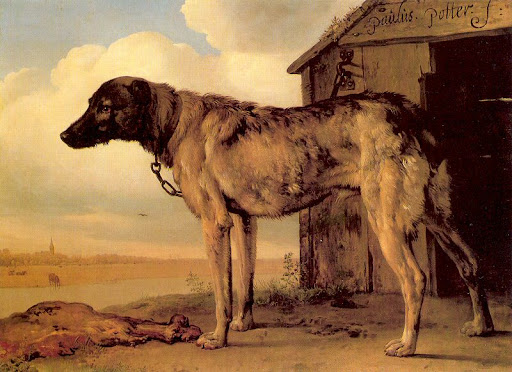
The next image is by Paulus Potter was a Dutch painter in the period of the 'Dutch Golden Age' who specialized in painting landscapes with animals. He was born in 1625 and died of tuberculosis at the young age of 28, in 1654. In spite of such an early demise he painted over 100 paintings and this one is truly a portrait.


The Wolfhound -- Paulus Potter -- 1650-52
(see it larger )

There is a sad dog that roams our neighborhood here in Mexico that looks a lot like Potter's wolfhound. Someday I'll get a picture of it.

The famous Mexican artist Rufino Tamayo (1899 – 1991) made several images featuring dogs. This one is called 'Perro Aullando' (Howling Dog).

Perro Aullando -- Rufino Tamayo -- 1960


I'm not sure if the black disk in the background, with the faint image inside it, is supposed to be the moon or the sun or what. Nor do I know why it is black. In any case this picture could just as well be in one of my 'art circles' posts!

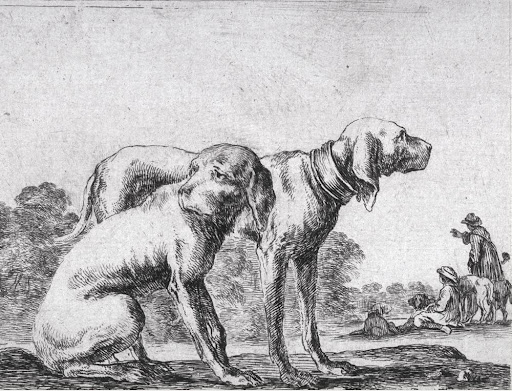
Next is a detail from an etching of Italian printmaker Stefano della Bella (1610 - 1664).

Two Hunting Dogs (detail) -- Stefano della Bella -- 1641
(see it larger)

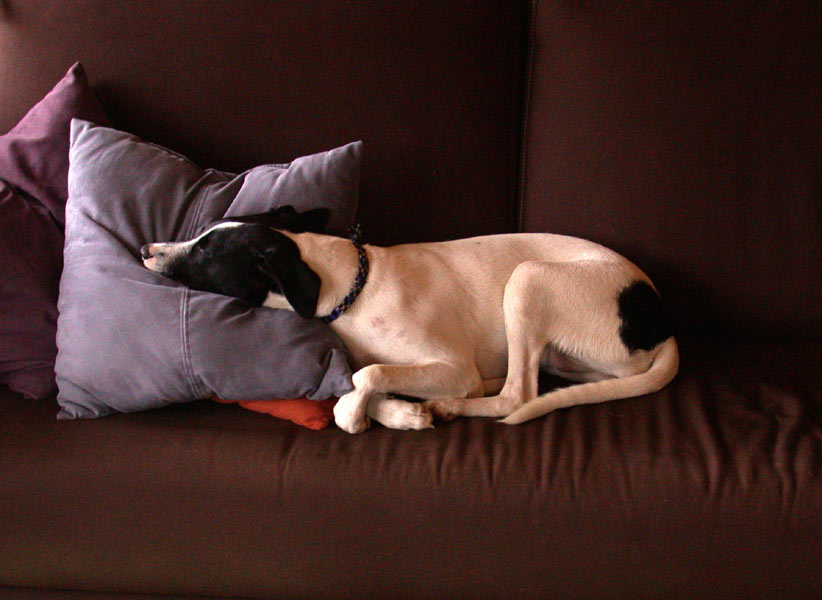
Acclaimed contemporary artist Lucian Michael Freud was born in Berlin in 1922, a grandson of Sigmund Freud. When about 11 years old, he moved with his parents to London to escape Nazi Germany. Here are two interesting paintings of Lucian Freud with dogs as important parts of their subject matter. I especially like this next image, partly because the dog reminds me a lot of our strange dog Cosi.

Eli and David -- Lucian Freud -- 2005-6

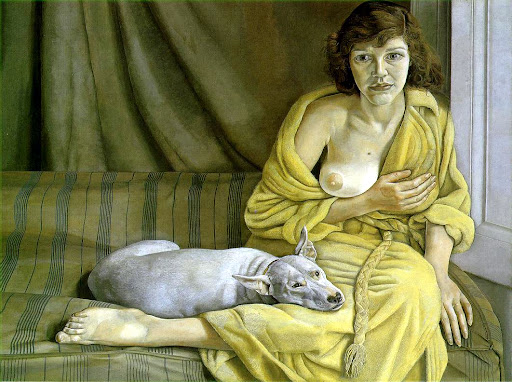
The next (and last) image is, I think, quite familiar. It is called 'Girl with a White Dog' but the subject is Freud's first wife, Kathleen Garman.

Girl with a White Dog -- Lucian Freud -- 1951-52
(see it larger)

Why her right breast is exposed, I have no idea -- especially since the white dog is already such an interesting subject!

Sunday, November 11, 2007

cascada post 23

Axolotl in Cruz Blanca

Recently I have been suffering from a severe case of blogblockitis which is an intransigent form of the more transient malady known as blogblock. One of my favorite blogs recently passed through the final solution and on to the other side. There was a certain beatic way in which it happened and I have to admit to a smidgen of jealousy. But, for unknown reasons, I trudge along still on this side.

If you are wondering what the title refers to, at least in my imagination, were you to speak the title without benefit of visual cues, you might misapprehend it as "accidentally in Cruz Blanca". Of course, if you are axolotl-aware you probably wouldn't. But just supposing that you did you wouldn't be entirely wrong: I was in Cruz Blanca twice a few years ago without even knowing it. Back then I thought it was all part of Matlalpa. In fact, when I mentioned to Kyoka, the young Japanese woman who has the strange fortune to work in Matlalapa, that the road ended in Matlalapa and that the only way to get to Cruz Blanca was to walk from there, she looked at me curiously but was far too polite to set me straight.

If now you are about to Google "Cruz Blanca", let me save you some trouble. Cruz Blanca is the name of at least five different towns in Mexico, and two are in the state of Veracruz. Is the true cross white? Our Cruz Blanca sits in the foothills of the nearly 14000 foot volcano, Cofre de Perote. It is just a little above Matlalapa which in turn is above Xico Viejo, whose indigenous precursor was, many believe, passed through by Cortes with his troops nearly 500 years ago. You can find this Cruz Blanca in Google Earth if you enter in this latitude and longitude: 19 28.424, -97 05.183. My GPS reports the elevation as 7290 feet.

Here is a picture from a little higher up looking back at Cruz Blanca (lower right) and Matlalapa (left side). If you follow the road back to the right until it seems to disappear you can see a few houses, which mark the upper limit of the small town Xico Viejo.


Cruz Blanca (right) and Matlalapa (left)


There is a small church at Cruz Blanca which honors 'San Isidro'. Here is its picture:


Iglesia 'San Isidro' at Cruz Blanca

The temporary structure on large bamboo stilts spanning the door is called an 'arco' and with much fanfare is marched to and erected at the church on the patron saint day of the town. This happens at most Catholic churches at least in this part of Mexico and is always a big festival.

Appropriately there is a white cross at Cruz Blanca. Here it is:

Cruz blanca a Cruz Blanca


Enigmatically, perhaps, there is also an axolotl at Cruz Blanca. And what is an axolotl? Well, when they are mature they are about nine inches long and look like this:

Axolotls as drawn by Jitka Horne

(I have to confess that I glommed this wonderful drawing from some no longer remembered internet publication. Jitka, if you or your publisher object please contact me). And here then is the much larger axolotl at Cruz Blanca, still under construction:

Axolotl (building far right) at Cruz Blanca

I'm afraid you can't see its tail, just its head, eyes, and mouth. So why are they building such a strange structure at Cruz Blanca? To understand you must know a little more of axolotls, which are unusual and interesting creatures.

Axolotl (in Spanish ajolote) is the common name for the species Ambystoma mexicanum, a kind of neotenic salamander. The 'mexicanum' part of the name derives from 'Mexico' because this animal only existed in Lake Xochimilco and Lake Chalco in the highlands of Mexico surrounding Teotihuacan (city of the gods) and just to its south the town of Xochimilco (city of flowers--from Nahuatl xóchitl = flower; milli = cultivated field, co = place). These lakes were full of axolotls which were a delicious and important food for the people of this region. These cities are ancient and are thought to have originated around 200 years before Christ, and by the 4th century (about the time Ethiopia was Christianised) Teotihuacan was the sixth largest city in the world.

Now of course the region is the giant megalopolis known as Mexico City and the lakes have long since been drained or dried up with only vestiges remaining as a few canals at
Xochimilco, in the southern part of Mexico City. As late as 1911 axolotls were still common in the markets of Mexico City. Whether they are still eaten and still available in markets I don't know, but I am skeptical because axolotls in the wild are now endangered.

As you probably know, each of our cells contains the complete genetic information of our bodies and so, in a sense, each cell contains a plan which if followed would could create a clone of ourselves. Unfortunately however it is only the youthful embryonic stem cells which can actually develop into a full clone, or into various parts of us, say a hand or a heart or skin depending on the environment that cues them. This is why stem cell research is so important, because only the stem cells are (as it is called) pluripotent.

Not so with the axolotl, for not only is it neotenic, that is it never metamorphoses like most salamanders into an adult form, but rather its youthful form including external gills continues into reproductive adulthood and throughout its life; but also its mature cells are pluripotent. Exactly why this is so is not well understood, but this attribute allows the salamander to regenerate lost limbs and other parts of its body.

These, then are the reasons that the axolotl is today important as a research animal in both regenerative medicine and stem cell research.

As a former (and maybe future) pool player I couldn't resist sharing the above diagram, grabbed from somewhere in the vast miasma of the Internet.

So now the reasons for the axolotl at Cruz Blanca emerge: axolotls will be raised for use in medical and pharmaceutical research. I am indebted to Alberto, friend and native speaker of Spanish, for talking to the local people at Cruz Blanca and explaining to me what they said. However, any errors here are mine since this posting is partly suppositional.
One small question. The great naturalist Alexander von Humboldt, for whom I have great regard, reported, as a result of his own exporations around 1803 or 1804, that the axolotl existed in other high altitude Mexican lakes besides the two mentioned above near Mexico City.

Alexander von Humboldt, as painted by Joseph Stieler, 1843


This is apparently not true today and I have not seen any confirming evidence that the salamanders reported by Humboldt in other lakes were in fact axolotls. If you can shed any light on this please comment or contact me.

Finally, on a personal note, I have had a persistent cough for nearly a month now. Happily I can report that a doctor in Xalapa has determined that it is not a contagious malady, and that following his prescriptions I am much better now. Still, though not suggested by my doctor, I cannot help but wonder whether this product,

which I have not yet been able to obtain, might have helped.

Friday, September 28, 2007

cascada post 22

Art Circles -- Part 2

Recently I learned that 'tondo' a shortening of the Italian 'rotondo' i.e. 'round' is the word used in the art world for round paintings as shown in my last post. Today let me move temporarily away from tondos and show some interesting art involving circles in which the paintings are not circular. First is a painting by Arthur Dove (1880-1946), arguably the first American abstract painter. Here it is:


Arthur Dove, 'Red Sun', 1935

I really like that large red sun, at once a natural object, a three dimensional spiral, and a symbol. The muted red stripes in the foreground seem agricultural. The image is both austere and yet warm. Even the artists signature in the lower middle seems part of the composition.

The next image is a painting of Chagall. I am not sure I can put into words why I find it compelling. Stare at it a bit, because it will just have to speak for itself.


Chagall, 'Compostion aux Cercles et à la Chèvre', 1920


Next is a strange glowing circle in a sort-of landscape by Christopher Orr. I hope you like it.


Christopher Orr, Untitled (Circle), 2006

Christopher Orr is a contemporary artist, born in 1967. You can find more about him, and see more of his work, by looking at his CV at IBID PROJECTS, London.

Now, let us step back two millennia and compare Christopher Orr's painting with this image on a classical Greek bowl:


Classical Greek Ceramic Work, 2000 or more years ago

There is a similarity in that both images feature a man seemingly enamored with a circle. In the first image the man seems amazed that he can make a circle of light with his finger, while perhaps in the Greek image the man is simply enjoying the pleasure of rolling a hoop. Certainly I do not know. Perhaps a more knowledgeable person can explain the symbolism, if any, of the circle. The rooster in the Greek image is the symbolic gift of love, or perhaps more often an offer understood to imply a desire for sex. But, in this case, there is no other person in the image. I still have to wonder if Orr might have been influenced by this or some similar Greek image from another era.
For today's last image let us move forward, past the Renaissance, to the Dutch Golden Age and examine this self-portrait of Rembrandt in older age:


Rembrandt, 'Self-Portrait with two Circles', 1665-1669

I think the circles add something important to the picture. Without them the painting would be much less interesting.

This series of circles in art will be continued in some future postings.

Thursday, September 27, 2007

cascada post 21

Art Circles

For a while now I have been collecting images of art in which circles played an important role. My collection now has over 350 images, mostly snagged from the Internet, some from Usenet groups, a few from photos I took, a few from things I scanned or created. For the most part I know little of the artists. Still I thought it would be fun to share some of these images and in some cases say something about the artists who created them. In the beginning I set myself some ground rules, such as no crop circles, no religious paintings in which a large halo around someone's head is the circle, no mandalas, no spheres or 3D sculptures, no plates or bowls, no manhole covers, no large moons or suns, no coins or medallions, no amazingly circular breasts, etc. In the end I occasionally broke many of my self imposed rules and just saved what caught my fancy. So it will be a little of everything that you see here, but always involving a circle in some way. Some of the artists are famous and some are nearly unknown, and perhaps some (for example me) are not even artists.

Let me start with Banksy's dictum. Banksy, as you may know is a famous (or infamous) graffiti artist many of whose works you can find on walls or buildings in London and elsewhere. His homepage with many interesting images you can find here
. Next, as one of his pieces of 'art', is his dictum:

banksy's dictum

Mind you, I am not arguing that this is one of Banksy's better pieces -- in fact it may be self-refutational -- but it was an easy lead-in for this article. So far as I know, Banksy mostly did not follow his own advice. I have only seen one of his other pieces that featured a circle. It is a sort of modern day Iwo Jima image with a political statement, but not particularly noteworthy otherwise, so I won't show it here.

Following this idea let me first show you some art pieces which, it seems to me, are rather arbitrarily framed by a circle. The circle in these cases does not seem to have much to do with the art other than to frame it. Let us start with the early Renaissance artist Botticelli (1445-1510). He is most often known as Sandro Botticelli, but his original name was Alessandro di Mariano Filipepi. Most of his life was spent in Florence, Italy. Probably his most famous work is Birth of Venus (c. 1485). Here we see a circular painting by Botticelli in which the Virgin offers her breast to the Christ Child:


Botticelli, 'The Madonna and Child with Three Angels', 1493

Notice that the hands of the angels at the left and right are chopped off by the circular frame and the base of the ceramic at the bottom is also truncated. It seems unlikely that Botticelli would have painted it that way. It seems more likely that a circular frame was imposed on a larger painting, maybe even a rectangular one. However, I have seen a digital version of this painting where noticeably more of the angles hands were visible, so this version has most likely been digitally cropped to a slightly smaller circle. Compare this with another of Botticelli's circular paintings:


Botticelli, 'Madonna of the magnificat', c 1485 (diameter 118 cm)

In this tranquil, peaceful painting the arcs above the crown and the leaning figure on the left suggest that Botticelli intended a circular frame. The bisected hand at the left may indicate that the circular diameter was a little smaller than Botticelli expected or wanted.

Botticelli's work, in addition to religious paintings like the above, includes many depictions of classical Greek mythology and many wonderful portraits of the powerful Medici family. The vast majority of his work is not framed by circles.

The next painting is by the Dutch artist Jan van Goyen (1596-1656) who painted mostly landscapes in the Netherlands and in Germany.


Jan van Goyen, 'Summer', 1625, diameter 33.5 cm

I downloaded this image from a usenet group a few years ago. A larger version (1600x1600 pixels, 400k bytes) can be found at the Rijksmuseum in Amsterdam. It is well worth clicking here to see the large version. A second Goyen circular painting is entitled 'winter'. Here it is:


Jan van Goyen, 'Winter', 1625

In the second image parts of the black diamond (or tilted square) shaped frame can be seen, insuring that the full extent of the circular painting is visible. The people seem to be carefully arranged to fit in this circular frame so Goyen must have consciously designed the piece for a circular frame. The circular frame does not seem to serve any artistic purpose, other than perhaps giving one the illusion of looking through a circular window or perhaps through a telescope, since low power telescopes were readily available in the Netherlands at the time this picture was painted. See here for an interesting history of the telescope. I do not know if Goyen made paintings for 'Autumn' or 'Spring'. Certainly most of his over 1200 paintings and 800 drawings were not circular.

Now let us jump to the year 1740, where we find this wonderful painting by the Dutch artist Jacob de Wit. Yes, it looks 3D, like maybe it is made out of plaster. But that is not the case. It is a painting. The children may be playing with fire, but they are also keeping warm in the winter.


Painting by Jacob de Wit, 1740

Now here is a curve ball for you:


Picasso, 'Nature morte à la chaise cannée', 1911-12 **

**
You are right if you are saying 'wait a minute', because, so far as I know Picasso did not paint any circular pictures. The original of the above is elliptical and you may well like it better. It should be easy to find using google image search. Still, the circular version above, which I created using Irfanview, doesn't look too bad. The rope and the cane are not painted -- at least I don't think they are -- as this is a multi-media picture.

I will continue with more 'art circles' in a future posting, and I will include non-circular pictures in which the circle plays an important role.

Tuesday, August 14, 2007

cascada post 20

Chile Extranjero Update

chile portrait
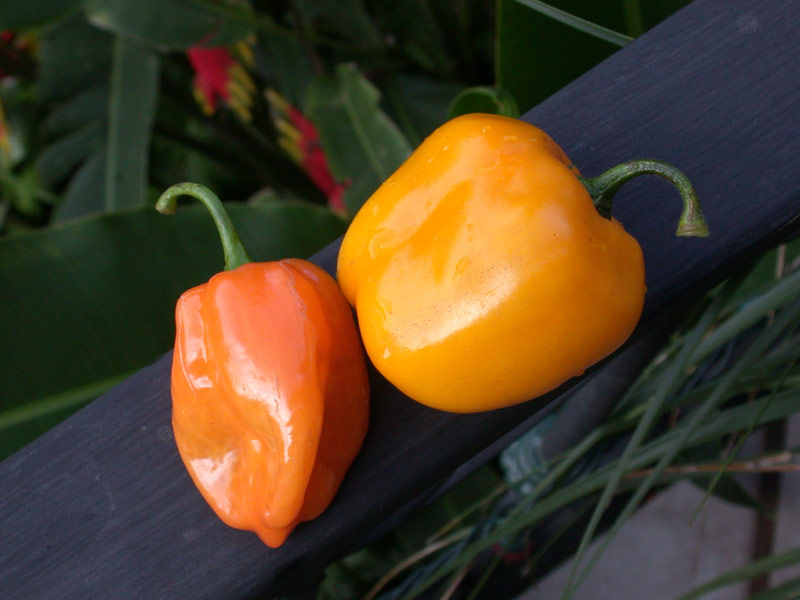
Chile habanero (left) and chile extranjero (right)
click here for a larger version

In a previous posting,
cascada post 8, I discussed the beautiful chile pepper (or chili pepper if you prefer that spelling) you see on the right in the picture above. Here locally, in Col. Ursulo Galvan, near Xico, in the state of Veracruz, Mexico, people call this chile "chile extranjero" which literally means "foreign chile". Apparently it originated in the Andes mountains of South America many millennia ago but was not introduced into Mexico until roughly 100 years ago.

The vast majority of chile peppers available in the USA are different varieties (or cultivars) of a single species: Capsicum annuum. The two chile peppers above are both unusual in that neither is Capsicum annuum. The chile habanero is Capsicum chinense (a misnomer since it is not of Chinese origin) and the chile extranjero is Capsicum pubescens. If it has
black seeds you know you have chile extranjero.

Both of these chiles (the habanero and the extranjero) are tasty but very hot. The interior part of the chile extranjero and the seeds are much hotter than the meaty part near the skin. Even just touching the seeds will cause your fingers to burn, even if you wash your hands. Be careful not to touch your eyes after cutting or preparing chile extranjero.

What I learned recently, which did not surprise me, is that 'chile extranjero' is just a local name. Here in the state of Veracruz the correct name is 'chile cera', which literally means 'wax chile'. In much of Mexico it called 'chile manzano' (apple chile), in the state of Oaxaca it is called 'chile canario' (canary chile, because it is yellow), and in the state of Michoacán it is called 'chile Perón'. Click on
this link for more information about Mexican chiles, and look under 'Chile Manzano' for more about chile extranjero, which from now on I will try to remember to call 'chile cera'.

Friday, July 6, 2007

cascada post 19

Col. Ursulo Galvan
Niños y Niñas

Colonia Ursolo Galvan is the name of the small town where I live. It is a small place, maybe 1000 people, about a mile or so off the main road, roughly halfway between Coatepec and Xico, in the state of Veracruz, Mexico. The 'Colonia' part of the name is because it is a 'Colonia' of Xico. This means that officially it is in the municipality of Xico, even though it is about three miles from the population edge of Xico. It is a peaceful, friendly, and generally nice place to live although is quite poor. Most people do not have cars, most cook on wood fires, and some have dirt floors. Still, there is community pride, and family pride, and pride in the state of Veracruz. There are lots of children here and they are, compared to many kids in the U.S., well behaved. They often play in the streets, and save for buses there is little traffic and it is safe. The picture (above left) shows about one third of the town.

When I first arrived here I was surprised to learn that this little town has four schools. One is a preschool which seems to have two or three levels, roughly like kindergarden and pre-kindergarden. There are two primary schools, and a secondary school called a 'Telebachillerato', roughly like a high school in the U.S. but much of the instruction is piped in via satellite TV. This seems to be fairly common in rural parts of Mexico.


Our friend Marie dropped by one day to invite us to attend Daniela's end of school celebration. Daniela (or Dani) is her preschool daughter, about four years old. At left is a picture of Dani, from about a year ago. That is a really serious pose. She is really a happy, smiley, busy little girl and a delight to be around.


So the time arrived and we went to Dani's school. Here are some pictures of her school.

The first is the sign on the front of the school. The second is the entrance to the school as decorated with balloons for the celebration.

|

Next the 'Bienvenidos' or welcome sign near the entrance and a portion of the playground.


After quite a wait during which the audience, proud parents, relatives and friends, was remarkably patient, the ceremony began. First some speeches, for which my Spanish was largely inadequate. Then came some sort pledge of allegiance and applause and finally each class of children (there seemed to be three) performed a dance or two. The sound system was terrible and the volume way too loud for it to handle, but it really didn't matter.


Here are some scenes of the children dancing, and the audience audience watching. All were dressed for the event. The first photo shows the little children waiting for their turn to dance. Next we see some of them dancing.

After the picture showing some of the audience [hopefully the next photo, this blogging software's preview never shows what the published post will look like] is a photo of Dani, kneeling as her part in the dance is about to begin. She is older and more mature than in the photo above taken about one year ago. Click on any photo to see it larger.


Soon came more dances of the other two class, each dressed in a different color.

The music was mostly Mexican, loud and crackly.


Then a real surprise for me. The oldest group came out to dance. I guess these were the graduating preschool children. An when the music came on it was the 1966 Percy Sledge favorite "When a man loves a woman".


What a strange feeling it was to see those little children, in this very foreign (for me) country dancing to that song to which I have my own set of memories.


And here they are at the very beginning of the dance:


I have to confess that I didn't stay till the very end of this event. Presumably the graduating preschoolers all got certificates and parents and children when home pleased and happy. In any case I was really glad I went and I came away proud of my little town, Col. Ursulo Galvan.

Saturday, June 23, 2007

cascada post 18

Video of Cascada

Here you have it, short on quality, but it is my cascada -- the view from my front window.


My Cascada

And here you have Cascada at her worst:

Cascada, August 6, 2006

That's all for today.